The 13 Desserts of Provence — A Complete Guide
Three white cloths, thirteen sweets and a Christmas Eve supper without meat: the Provençal table explained — where the number came from, what each sweet stands for, and how to build one at home.
Mediterranean Flavors
Mediterranean Cooking Expert
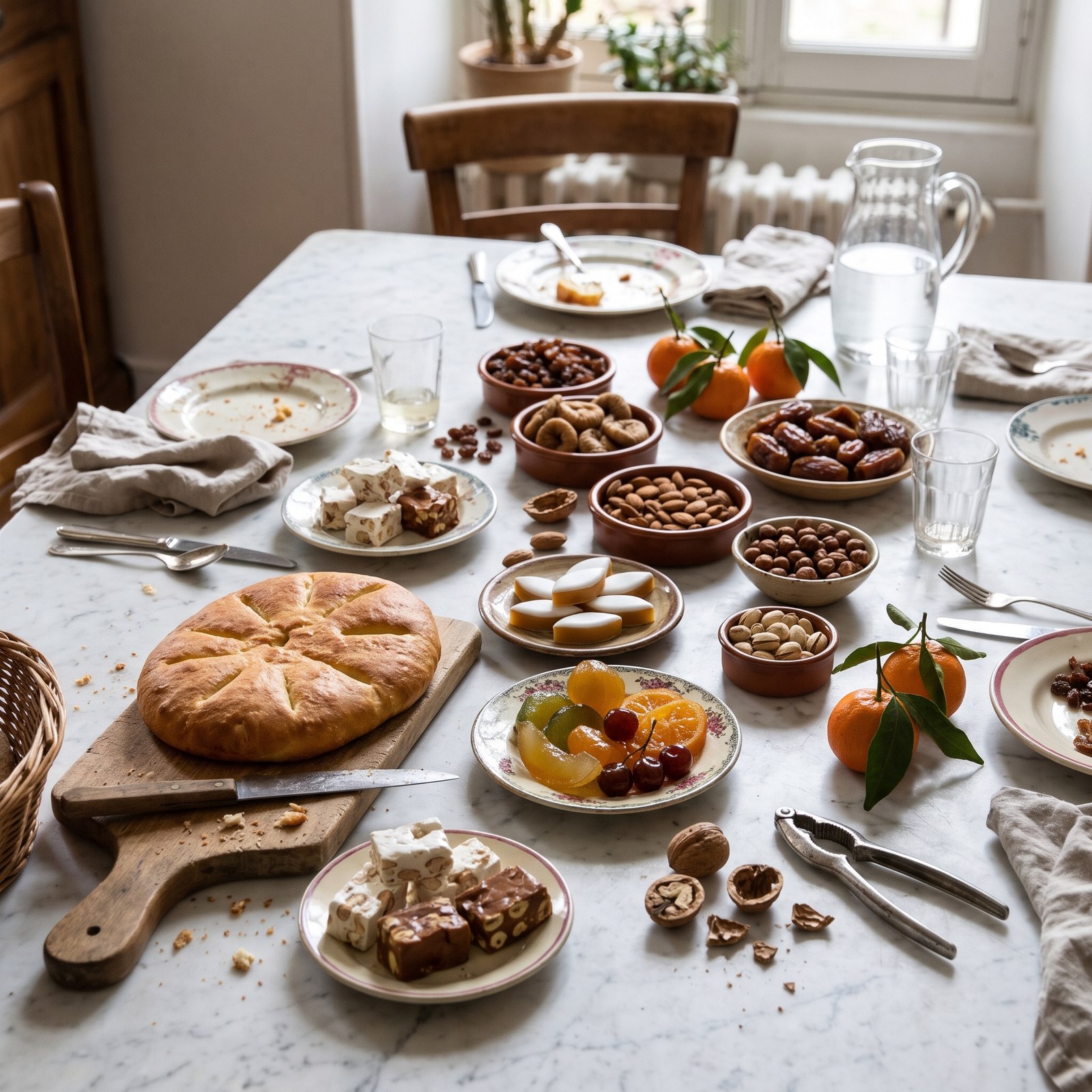
On Christmas Eve in Provence the table is laid with three white cloths, three candles and thirteen sweets: nuts, dried fruit, candied peel, dates, two kinds of nougat and a flat bread made with olive oil. The supper before it is lean — fish, vegetables, no meat — and the sweets close it before midnight mass. The abundance is very old. The number thirteen is not.
The thirteen is a twentieth-century count
The oldest description of the Provençal Christmas table dates from 1683. The Marseille priest François Marchetti recorded three white cloths and thirteen loaves — twelve small for the apostles, one large for Christ — and named fruit and olive-oil bread without counting any sweets. Two centuries of inventories followed, all abundant and none of them counted.
The first count appears in 1885, in a Marseille chronicle, and it says twelve. Thirteen enters the record only in 1925, when the Aubagne writer Joseph Fallen insisted in La Pignato that thirteen were required, “not one fewer”. A year later Marie Gasquet described a thirteenth plate, finer than the rest, filled with dates. By the early 1930s the Musée du Terroir Marseillais had fixed a display table, and the thirteen became the marker of Provençal identity it is today.
Modern lists are indicative at best, including the one four Aix associations declared the reference in the 1990s; researchers have counted more than fifty-five compositions. What is genuinely old is not the number but the pattern: a wide tray of nuts and preserved fruit at the end of a winter feast. The same tray appears at Sephardic Rosh Hashanah, on Greek tables at the turn of the year and in Catalonia at Christmas. Thirteen is the Provençal signature on a Mediterranean habit.
What the thirteen stand for
The cipher is Christ and the twelve apostles. The four mendiants — raisins, walnuts, dried figs and almonds — stand for the four mendicant orders: Dominicans, Augustinians, Franciscans and Carmelites. Dates recall Christ arriving from the East. The two nougats, white and black, are read as purity and penitence, and in stricter households as good and evil.
Before the sweets, the table
The thirteen close the gros souper, the lean Christmas Eve meal of seven dishes. On 4 December, Sainte-Barbe, wheat is sown in three saucers of damp cotton; if it greens by Christmas the year will be good. Three cloths, three candles, three dishes of wheat: the Trinity, repeated. In parts of Languedoc nothing is cleared after the meal, not even crumbs, because the family dead are expected to eat.
The thirteen, one by one
- Pompe à l’huile — flat bread of olive oil, sugar and orange-blossom water, no butter; torn by hand, never cut.
- Fougasse or gibassié — the second bread of the table; the gibassié of the Aix country is the richer of the two.
- Nougat blanc — honey, egg white, almonds and pistachios; soft, pale, cut in slabs at the table.
- Nougat noir — honey cooked harder with whole almonds until it sets dark and glassy; it shatters instead of bending.
- Amandes — raw or roasted, one of the four mendiants and the base of half the sweets.
- Noix et noisettes — in shell where possible, cracked at the table with a nutcracker.
- Figues sèches — the Franciscans of the quartet; often pressed flat and strung.
- Raisins secs — the Dominicans; muscat from the Rhône valley when it can be found.
- Dattes — served whole; the sweet most families honour with the finest plate.
- Fruits confits — candied orange, lemon and melon: heavy, translucent, sliced thin.
- Pâte de coing — quince paste, firm enough to cut, in small cubes with the nuts.
- Calissons d’Aix — almond and candied-melon paste under royal icing; a late arrival on the list, obligatory in Aix.
- Fruits frais — oranges and mandarins, a green winter melon, grapes, apples and pears further north.
Oreillettes, chestnuts in vin cuit, jam and small biscuits rotate through the remaining slots from village to village. The rule that survives everywhere: each sweet on its own small plate, all thirteen at once.
A table the Mediterranean diet can live with
Strip the religious framing and the composition reads like the diet itself: walnuts, almonds, hazelnuts, figs, raisins, dates, olive-oil bread, fresh fruit. No cream, no butter, no chocolate. The sweets are fruit preserved by drying, candying or cooking in honey, which is why a table of thirteen can end a long meal without turning into a pastry counter. Serve one of each, slowly, with a small glass of vin cuit or muscat.
Building one at home
Buy the fruit and the nuts on quality and make only the bread. Bake the pompe à l’huile the day before: 500 g strong white flour, 10 cl olive oil, 15 g fresh yeast, 60 g sugar, 20 cl warm water, a spoonful of orange-blossom water, a pinch of salt. Knead, prove twice, flatten, score, bake at 180 °C for 20–25 minutes.
Bake it on 24 December — it stales fast. And the table is meant to look excessive: thirteen plates, no composition, no symmetry.
For the wider pattern — nuts, legumes, olive oil, fish, sweets built on fruit — the free 7-day Mediterranean meal plan is a working week of it, shopping list included. More on the site: torrone, tarta de Santiago, portokalopita, melomakarona, baklava, pastéis de nata.
Sources: Wikipédia FR, Treize desserts; Mairie d’Aix-en-Provence, Traditions de Noël en Provence; Brigitte Poli, Les 13 desserts provençaux.
Related Articles
Feast of the Seven Fishes — Italian Christmas Eve
Seven fish dishes, one table, no meat: the Italian Christmas Eve menu explained — where la Vigilia comes from, why seven, and how to cook the whole dinner without losing the kitchen.
Read More →Mediterranean meal prep: 5 days of lunches
The Mediterranean diet does not ask for advanced technique — it asks for logistics. The secret to eating well every day is not complicated recipes; it is a two-hour Sunday session:
Read More →Get More Cooking Tips
Join our community and get weekly Mediterranean cooking tips delivered to your inbox.